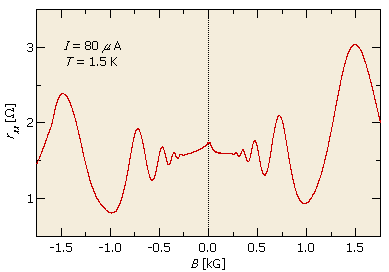
A few years ago it was realized that when a 2DES is subject to a constant dc current I and varying magnetic field B, its differential resistance r = dV/dI acquires prominent oscillations [1] (see Fig. 1). These oscillations are believed to arise from large-angle elastic impurity scattering between Hall-field tilted Landau levels and can be termed Hall field-Induced Resistance Oscillations (HIRO). HIRO are periodic in inverse magnetic field and are controlled by the ratio of two length scales, the cyclotron diameter 2Rc = 2vF/ωc and the real space inter-Landau level spacing ΔY = ħωc/eE:
Here, ωc = eB/m is the cyclotron frequency, m is the effective mass of the carrier, ħ is the Planck constant, E = IB/enew is the Hall electric field, ne is the electron sheet density, and w is the width of the Hall bar mesa. [1,2] These length scales can be mapped onto energy scales yielding:
Here ħωH = eE(2Rc) is the energy associated with the Hall voltage drop across the cyclotron diameter. Experiments show that the HIRO maxima are found near integer values of εdc [3]:
Similar to MIRO, HIRO persist to magnetic fields about an order of magnitude lower than the onset of the Shubnikov-de Haas oscillations. While HIRO are best observed at T ≈ 1 K, they remain relevant at least up to several Kelvin.
To explain nonlinear resistivity in high LLs both “displacement”, based on large-angle scattering off of short-range disorder, and “inelastic”, based on the oscillatory dc-induced correction to the distribution function, mechanisms were theoretically considered [4]. It was found that the “inelastic” mechanism is important only at very weak electric fields and cannot account for the oscillations. On the other hand, the “displacement” mechanism [4,5] provided excellent description of the experimental results; the oscillatory correction to the differential resistivity at 2πεdc > 1 is given by [6]

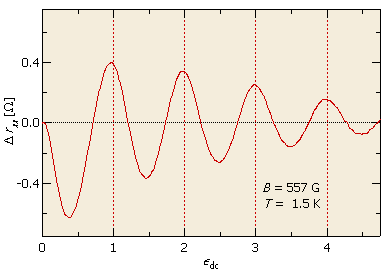
Experiments in dc-driven 2DES are interesting in several respects. First, one can easily cover a wide "frequency" range and perform controlled "frequency" sweeps (see Fig. 2), which are difficult in microwave experiments. Second, one can easily explore the regime of small ε, which normally would require very high magnetic fields.
[1] C.L. Yang, J. Zhang, R.R. Du, J.A. Simmons, and J.L. Reno, “Zener Tunneling Between Landau Orbits in a High-Mobility Two-Dimensional Electron Gas”, Phys. Rev. Lett. 89, 076801 (2002) [abstract] [full text]
[2] A.A. Bykov, J. Zhang, S. Vitkalov, A.K. Kalagin, and A.K. Bakarov, “ Effect of dc and ac excitations on the longitudinal resistance of a two-dimensional electron gas in highly doped GaAs quantum wells”, Phys. Rev. B 72, 245307 (2005) [abstract] [full text]
[3] W. Zhang, H.-S. Chiang, M.A. Zudov, L.N. Pfeiffer, K.W. West, “ Magnetotransport in a two-dimensional electron system in dc electric fields”, Phys. Rev. B 75, 041304 (2007) [abstract] [full text]
[4] M.G. Vavilov, I.L. Aleiner, L.I. Glazman, “ Nonlinear resistivity of a two-dimensional electron gas in a magnetic field”, Phys. Rev. B 76, 115331 (2007)[abstract] [full text]
[5] X.L. Lei, “Current-induced magnetoresistance oscillations in two-dimensional electron systems”, Appl. Phys. Lett. 90, 132119 (2007) [abstract] [full text]
[6] M. Khodas and M. G. Vavilov, “Effect of microwave radiation on the nonlinear resistivity of a two-dimensional electron gas at large filling factors”, Physical Review B 78, 245319 (2008) [abstract] [full text]
[7] A. T. Hatke, M. A. Zudov, L. N. Pfeiffer and K. W. West, “Role of electron-electron interactions in nonlinear transport in 2D electron systems”, Physical Review B , (2009) [abstract] [full text]